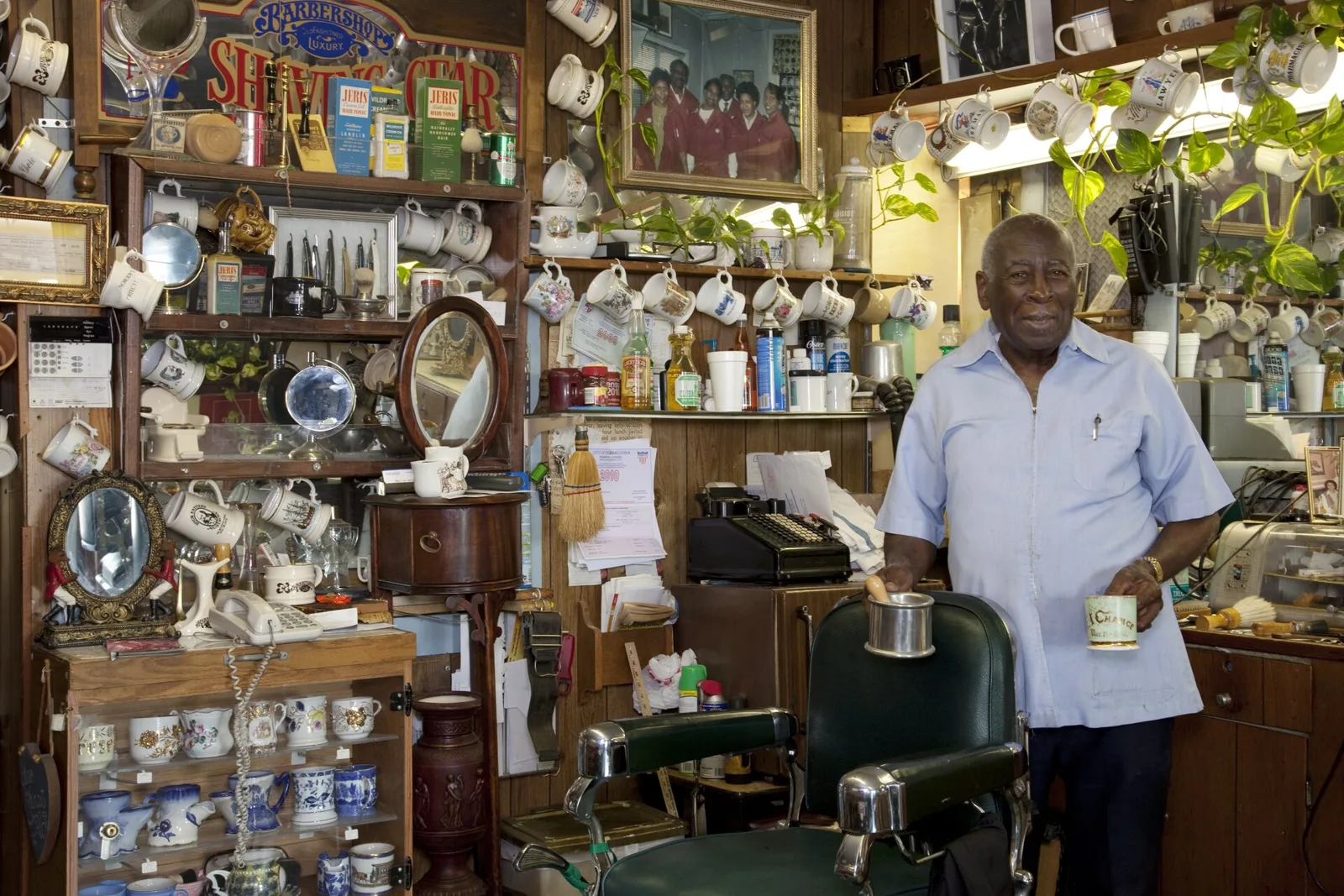
The city opened the $1.4 million plaza honoring the Rev. Thomas Linton on Oct. 21, with story panels, a timeline walk and an art installation by Caleb O'Connor.
The City of Tuscaloosa opened Linton’s Barbershop Plaza with a ribbon cutting Wednesday morning. The plaza stands at 1305 T.Y. Rogers Jr. Ave., on the site of the barbershop that sheltered Autherine Lucy in 1956 and the wounded marchers of Bloody Tuesday in 1964.
Updated Oct. 22: the plaza has opened. This story now reports the ribbon cutting, from the city’s release.
The plaza honors the Rev. Thomas Linton, who spent the last 40 years of his life preserving the history of Bloody Tuesday and the civil rights movement. He turned his barbershop into a living museum, the city said in its release on the ribbon cutting.
The Linton family sold the barbershop land to the city. His civil rights artifacts went to the Tuscaloosa Civil Rights History & Reconciliation Foundation, the city said.
What was said Wednesday
“Too often, we see efforts to overlook or forget the history that helped shape our country,” Mayor Walt Maddox said. “The City of Tuscaloosa has chosen to stand in the gap.”
“Today is an opportunity to recognize leaders in our community,” council member Joe Eatmon said.
Tim Lewis, co-president of the foundation, called the plaza “step one towards making a bigger statement here in Tuscaloosa.” He said the goal is “having a place where we can show all of the things Reverend Linton collected.”
What the plaza is
The plaza is an Elevate Tuscaloosa project with an expected cost of $1.4 million. Its stated aim is to “expand the Civil Rights Trail and encourage meaningful connections and interactions,” according to the project page.
The city broke ground on Aug. 14, 2025. Its groundbreaking announcement said the plaza would include story panels, a mural wall and better lighting and security.
As opened, the city said, the plaza has:
- an art installation by artist Caleb O’Connor
- story panels on Tuscaloosa’s civil rights milestones
- a central walkway with a timeline
Construction was first expected to finish in early 2026.
Why this spot matters
The Howard-Linton Barbershop is a stop on the Tuscaloosa Civil Rights History Trail. The trail’s marker, put up in 2019 by the Tuscaloosa Civil Rights History Task Force, tells two stories about the shop. Its full text is transcribed by the Historical Marker Database.
In February 1956, Autherine Lucy had just started classes at the University of Alabama under a court order. On Monday, Feb. 6, a mob the marker estimates at more than a thousand people met her on campus. She escaped and took refuge in the barbershop. Armed Black men formed a guard around the shop. Later that afternoon, five cars pulled up, and Lucy was hidden in one of them and driven to Birmingham.
On June 9, 1964, the Rev. T.Y. Rogers Jr. led a march from First African Baptist Church toward the new county courthouse, which had opened with segregated restrooms and water fountains. Police and white extremists attacked the marchers. The marker says 34 people went to the hospital and 94 to jail, more than on Bloody Sunday in Selma a year later.
Many of the wounded retreated to the barbershop, where neighbors gave first aid. The Rev. T.W. Linton called U.S. Attorney General Robert Kennedy and the Rev. Martin Luther King Jr., the marker says.
What was said at the groundbreaking in 2025
Council member Joe Eatmon said the shop was his first job. “I had the opportunity to sweep hair for a free Coke and a haircut from Mr. Linton,” he said at the August 2025 ceremony. He said he hoped the plaza would give young people the same chance he had to “sit and listen to leaders in our community.”
“This is indeed holy ground; for the City, for the Civil Rights Movement and our Nation,” Mayor Walt Maddox said.
What it means for you
- The plaza is open at 1305 T.Y. Rogers Jr. Ave., a stop on the city’s civil rights trail.
- Our history and landmarks guide lists more places to visit, and things to do in Tuscaloosa has the week’s events.
Have your say